Poker
Live Poker
Poker is widely known, but not everyone knows how to play poker. Poker is a skill-based game in which chance and strategy influence your outcomes.
Poker is part of the traditional table game family involving elements of chance, strategy and player psychology. Players are randomly dealt a combination of cards and draw from shared community cards. Each player bets according to what they believe their hand is worth. During a round of play, players can either check (no bet), fold their cards against a bet, match (call) the bet or raise the bet. Sometimes ‘bluffing’ is involved to advance strategy. The goal of poker is to win chips from other players through bluffing or producing the highest-ranking hand. The winner takes the pot at the end of the game. The outcomes of poker are influenced by how players play their cards.
Game set up
Live poker cash games and tournaments are usually played with two to 10 players per table with a professional dealer using a standard 52-card deck. The game uses chips for betting and markers for identifying the dealer, big blind and small blind for each round. The two players to the left of the dealer position post the small blind and the big blind, which are forced bets required to create the initial pot and build incentive for participating in the hand.
How to play
The instructions below are formatted for Texas Hold’em Poker, however the betting process is consistent amongst most Poker-styled games.
- The two players to the left of the dealer post the small blind and the big blind, which are forced bets required to start the action.
- Each player receives two Hole Cards (face down).
- The first betting round, known as the Pre-Flop, starts with the player to the left of the big blind. Each player can choose to fold, call or raise.
- Three community cards are dealt face up in the center of the table. Known as the flop, these cards are shared by all players.
- Players can now bet again, starting with the player to the left of the dealer. The choices are to fold, check, call or raise.
- A fourth community card called the turn is dealt face up and placed next to the community cards.
- Another round of betting occurs following the turn.
- A fifth and final community card known as the river is dealt face up.
- The last round of betting takes place before the remaining players
reveal their cards in a showdown. The player with the best five-card poker hand wins the pot.
Hand Rankings
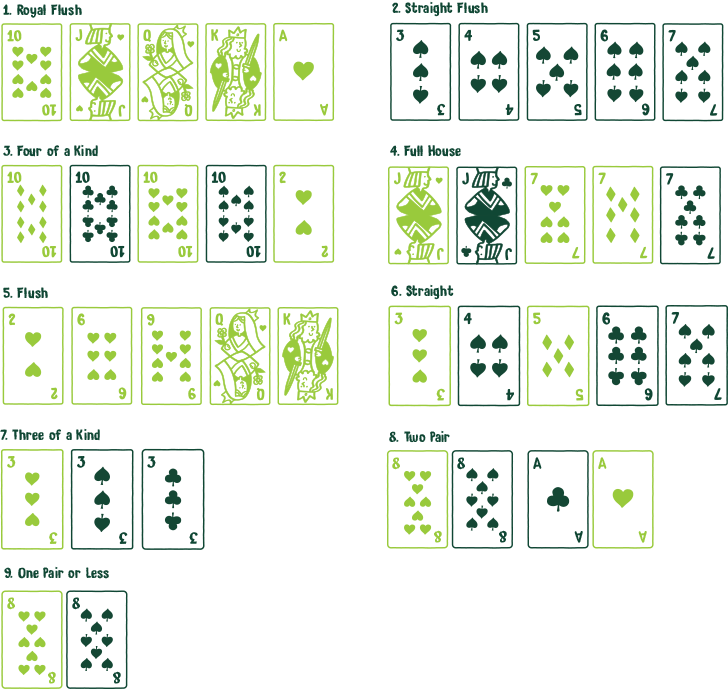
Variations
There are many different variations of live poker played in person or online. These variations may have different rules, pot limits, objectives and procedures. However, the hand rankings are consistent amongst the different game types. The most common games are Texas Hold’em, Seven Card Stud or Omaha. Game types and options may vary by casino or online operator.
Seven Card Stud:
Rather than using blinds, every player contributes an ante before the cards are dealt. The amount of the ante is set according to the game’s stakes. Each player receives two cards face-down and one card face-up. After the first round of betting, three additional cards are dealt face-up and one card face-down with a round of betting after each card. To win, you must be the player with the best five-card poker hand from a total of seven cards dealt.
Omaha:
While playing Omaha, each player is dealt four cards and must make the best five-card poker hand. Each player attempts to achieve the best five-card poker hand by using exactly two of the four cards dealt to them and three of the five community cards. As in Hold ’em, blind bets are posted before any cards are dealt. Each player then receives four cards face down. The five community cards are dealt face-up.
Dealers Choice: The dealer chooses the type of poker or variant that will be played for that hand.
Limits
Spread Limit: This game has a predetermined betting structure (an established minimum and maximum bet) and allows for any amount within that range to be wagered.
Pot Limit: Maximum bets and raises are limited to the current size of the pot. For example, a pot starts with $100, and as the first player to act, you can bet any amount from the minimum up to $100. If another player bets $50 and you want to raise, you must first call the $50 (making the pot $150), then you can raise by up to $150 more, so your total action could be $50 (call) plus $150 (raise), for a total of $200.
Limit: The minimum and maximum amount of a bet is fixed in this game.
No Limit: Players are allowed to wager any or all their chips in a single bet. There is a minimum bet but no maximum. For example, a player can bet a minimum of $2 to a maximum of all their chips.
Poker Terminology
All In: Betting all your remaining chips on a single hand.
Ante: The initial bet placed by the player before any cards are dealt. This is a required wager to participate in the round.
Blinds: Blinds are forced bets posted by players to the left of the dealer button in flop-style poker games. When there are two blinds, they are called the small blind and the big blind. This is also the position that starts the action in every round except pre-flop.
Bluff/Bluffing: Betting or raising with a weak hand to trick opponents into thinking you have a strong one. The goal is to make other players fold better hands so you can win the pot without showing your cards.
Button: Often used to refer to the dealer position, which is the position whose turn to bet comes last. Being "on the button" is therefore the most advantageous and most profitable position in poker.
Burn Card: A card discarded from the deck before community cards are dealt, used to prevent cheating.
Check: Choosing not to make a play bet at a given opportunity, while retaining the option to bet later in the round.
Community Cards: Five cards dealt face up in the center of the table. All players use these cards in combination with their pocket cards to make the best five-card poker hand.
Flop: The first three community cards dealt simultaneously after the initial betting round.
Fold: Surrendering your hand and forfeiting your Ante and Blind bets, ending your participation in the current round.
Hole Cards (also called Pocket Cards): The two private cards dealt face down to each player at the start of the round.
Raise: Increasing the size of the Play Bet when allowed.
River: The fifth and final community card dealt after the Turn.
Show one – Show all: If a player decides to reveal their hand to one player, they are required to reveal it to every player at the table.
String Bet: When a player tries to place a bet by moving chips into the pot in two or more separate actions, without saying how much they want to bet first. This is not allowed because the player could change their mind based on other players’ reactions. Instead, a player must either state their bet amount beforehand or put all their chips in at once.
Table Limit: The minimum and maximum bets allowed at a particular table.
Turn: The fourth community card dealt after the Flop.
Related Material

Texas Hold'em
Create the best five-card poker hand possible, using two cards you’re dealt in combination with the five community cards.

What's your playing style?
The Positive Play Quiz is a quick, anonymous tool designed for anyone interested in learning about their gambling habits.
Contact Us
Can't find what you are looking for? Contact GameSense today with any questions or call the GameSense Info Line at 1-833-447-7523
Learn More